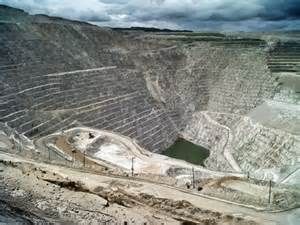
In 1971 the Island Copper Mine opened up on Vancouver Island, British Colombia in Canada. It was an open pit mine and at it’s peak, employed 900 people. The pit produced by the mine was 2400 meters long, 1070 meters wide and had a depth of 400 meters.
Luckily there weren’t many environmental impacts from the mine due to the careful planning prior to it’s opening and the precautions taken. Seepage from the mine was restricted by a 33 meters deep, 1219 meters long seepage barrier. All water run-off from dumps was controlled by a system of water management. Although there was evidence that the water became more turbid, there was no measurable effect on productivity of the biological systems. The reduction in species diversity on the seabed was the biggest effect; a site near the mine had 15 species in 1995 whereas one unaffected site had 41. Despite early fears, no dead zone was formed.
The waste from the mine, which is called tailings and made up 99.87% of the total one billion tonnes of material removed, was disposed of in the sea. The percentage of waste means that only 0.13% out of the total one billion tonnes of material removed was usable, which is about 1,331,372.7 tonnes. The mine stayed open for 25 years, closing in 1995 because of insufficient amounts ore left to make further extractions. That is a lot of time spent to obtain not that much material.
Seepage barriers are constructed in order to control and mitigate the flow, or seepage, of water. Depending on the seepage barrier method employed, they are constructed using soil and bentonite, cement and bentonite, concrete, balanced stable cement grout, or chemical grout.
Dead Zone: a place or period in which nothing happens or in which no life exists.
Tailings, also called mine dumps, culm dumps, slimes, tails, refuse, leach residue or slickens, terra-cone (terrikon), are the materials left over after the process of separating the valuable fraction from the uneconomic fraction of an ore.